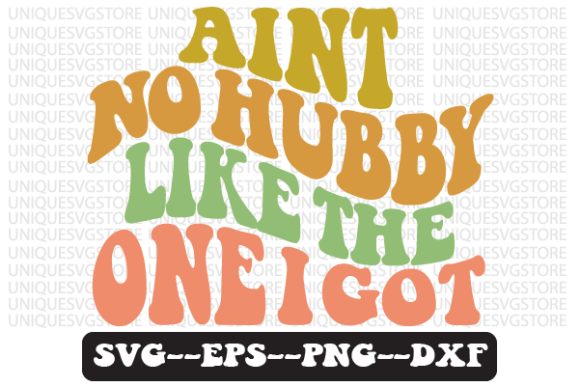
Aint No Hubby Like the One I Got SVG
Let’s be real: I’ve opened hundreds of embroidery files labeled “funny,” “retro,” or “anniversary” — and most fall flat under needle and thread. So when Aint No Hubby Like the One I Got SVG landed in my inbox, I didn’t just eyeball it on screen. I pulled up my Bernina, grabbed a scrap of midweight cotton twill, and stitched it onto a mock-up tote bag — the kind I’d actually sell at my local craft fair or list on Etsy as a limited-run anniversary gift.
Retro Charm, Not Retro Compromise
First impression? This isn’t a pixelated meme slapped into vector form. The lettering has intentional weight — slightly uneven, with subtle hand-drawn quirks in the curves of the “A” and “G.” There’s no excessive ornamentation, no distracting flourishes. Just clean, confident retro typography that reads instantly, even at 3.5 inches wide. It feels warm, personal, and authentically celebratory — not ironic or detached. That matters. When you’re stitching something meant to hang in a kitchen, drape over a shoulder, or wrap around a baby’s onesie, tone is half the design.
Where It Shines (and Where It Needs Guardrails)
I tested Aint No Hubby Like the One I Got SVG across three real project types: a medium-weight unisex sweatshirt, a linen tea towel, and a cotton-poly blend baby onesie. Here’s what held up — and where I paused.
- Sweatshirt embroidery: Worked beautifully on the chest placement. The letter spacing stayed legible, and the moderate stroke width avoided “thread blobbing” common with overly condensed retro fonts. Used tear-away stabilizer + light cutaway backing — no puckering.
- Tea towel (linen): Crisp and charming on the front corner. Linen’s natural slub added texture without muddying the lines. No fill-stitch density issues — this isn’t a dense machine embroidery design heavy with satin stitch coverage. It breathes.
- Baby onesie: Tricky — but doable. I resized to 2.75" wide and used ultra-light cutaway stabilizer. The “y” tail and lowercase “g” loop stayed defined. Still, I’d recommend skipping this for sub-24-month garments unless you’re confident in your hooping and tension. Tiny letterforms + stretchy fabric = risk of skipped stitches or shadowing.
What You’ll Want to Watch For
This isn’t a “drop-in-and-stitch” file for every surface. As a designer who ships embroidered goods daily, I flag these considerations before committing to production:
- Hoop size & detail retention: At under 4" wide, it fits standard 4x4 hoops — great for small-batch makers. But zoom in: the inner curve of the “O” and crossbar of the “t” are narrow. If your machine’s smallest needle is 75/11 and your digitizing isn’t optimized, those spots can feather or thin out. Always test on scrap first.
- Fabric texture vs. clarity: On fleece-lined hoodies or terry cloth towels? Add a layer of topping (like Sulky Solvy) to prevent thread sinking. On dark fabrics, avoid light pastel threads — go for heather gray, navy, or rust for contrast that reads cleanly.
- Commercial use reality: The description says “Printable product,” but if you’re selling finished embroidered items (not just the digital file), confirm licensing covers commercial embroidery. Many Graphics category files allow small-batch handmade use — but not wholesale or POD integration. Check before listing on Etsy or bundling into boutique branding.
Why It Works for Real Craft Businesses
As an Etsy seller and small shop owner myself, I judge designs by how they perform *beyond the stitch* — in photos, in gifting context, in repeat customer trust. Aint No Hubby Like the One I Got SVG lands because it’s specific without being exclusionary. It’s clearly for couples, yes — but it avoids cliché (“Mr. & Mrs.”) or overused tropes (“Wifey Approved”). That specificity builds authenticity. Buyers recognize it instantly. They tag friends. They screenshot it for Pinterest. That’s organic engagement — not something you engineer with SEO alone.
It also scales well across product types: as a standalone chest embroidery on a black crewneck, it reads as boutique-worthy; as a small patch sewn onto a denim jacket lapel, it adds personality without shouting; as part of a trio of anniversary designs (with matching “Wifey Approved” and “Forever & Always” variants), it strengthens brand consistency for your craft business.
Practical Designer Notes Before You Stitch
Before sending this to your hoop or uploading to your embroidery software:
- Run a black-and-white mockup — does the shape hold up without color crutches?
- Check thread color contrast on both light and dark fabric swatches. Some retro palettes look great digitally but vanish on charcoal.
- Review stitch density in tight curves — especially the lowercase “g” and “y.” If your software shows >12,000 stitches in a 3" area, consider simplifying or adjusting underlay.
- Use appropriate stabilizer: medium tear-away for stable wovens, cutaway + topping for knits or textured weaves.
- Confirm whether your version includes multiple formats (PES, DST, JEF). If not, convert carefully — avoid auto-trace tools that oversimplify letterforms.
In short: Aint No Hubby Like the One I Got SVG is a quietly capable design. It doesn’t try to be everything. It’s not oversized, not overly detailed, not trend-chasing. It’s warm, readable, and rooted in real human sentiment — exactly what makes a Crafts category asset endure beyond seasonal traffic spikes. Whether you’re embroidering a last-minute anniversary gift or building a cohesive line of personalized apparel, this one earns its place in your working library — as long as you treat it like the thoughtful design it is, not just another printable graphic.